
👯♂️ The Twin Sister of the Dragonfly 🤩 The Damselfly ✨
🦋 A follow-up story that connects beautifully to Chapters Zoology and Ecology in the Biology Album. 🌍✨ It invites children into the twin lives of the damselfly — a creature that begins underwater, breathes through gills, and later takes to the sky with glittering wings and eyes that see in every direction. This story highlights compound eyes, aquatic metamorphosis, and mating adaptations,.The damselfly becomes a doorway to studying pond ecosystems, predator-prey relationships, and structural adaptations. It naturally extends into classification work, anatomy sketching, and comparison with its better-known twin — the dragonfly. Children are invited to explore: Which other insects begin in water and take flight later? Do all aquatic insects breathe through gills? What does the world look like to a creature with compound eyes? 💧👁️🪽
BIOLOGY STORIES
5/18/20253 min read
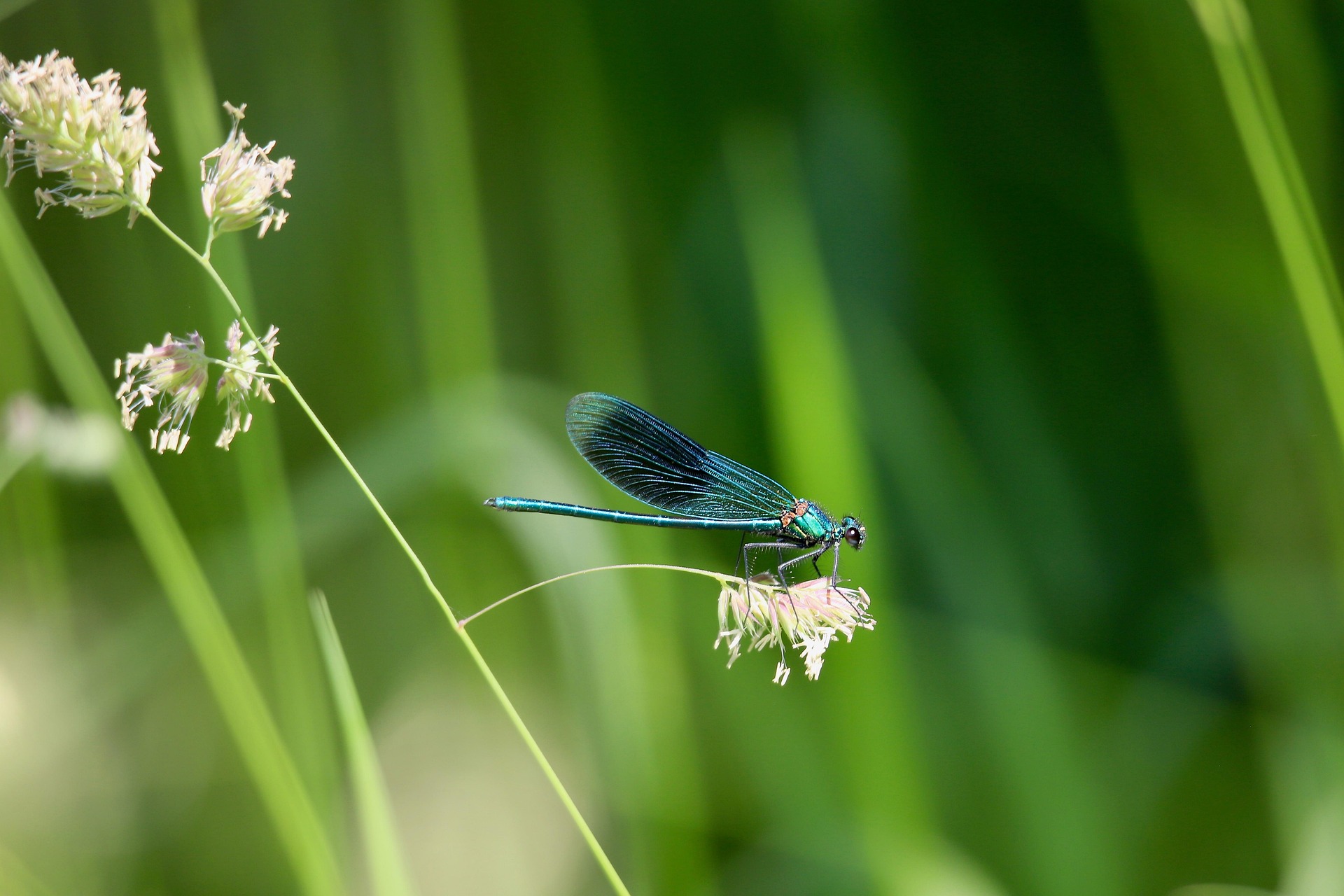
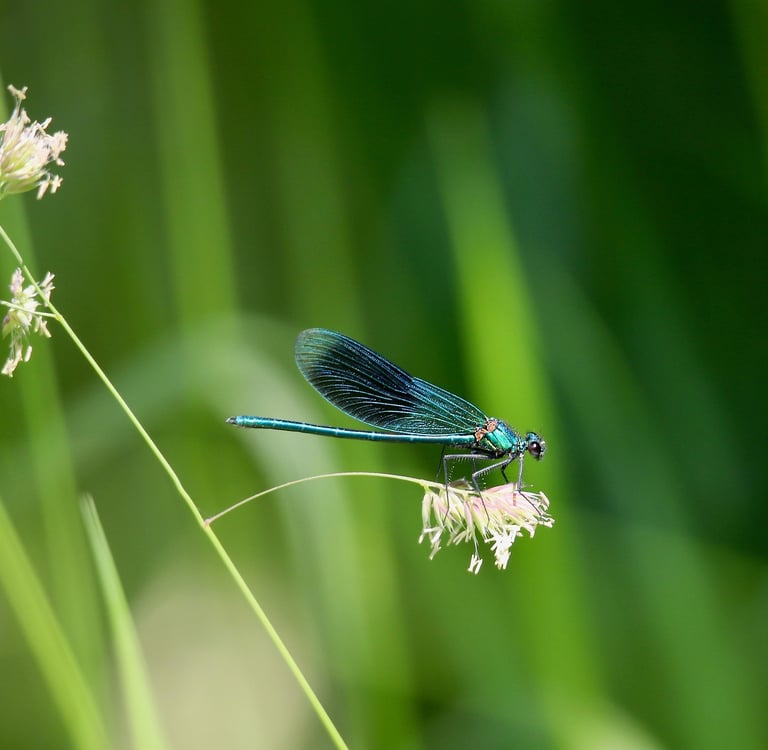
When you sit quietly by the edge of a pond in late spring, the water barely moving, sunlight dancing on the surface 🌞, something delicate may drift past your eyes — not a fly, not a bee, but a tiny creature with glittery wings and an abdomen thin like a needle.👀 A creature that glides like a ribbon over water, landing with wings neatly folded like a bookmark pressed between pages. 📖✨ That’s not a dragonfly — it’s his twin sister: the damselfly. 🦋
Her name comes from a time when people called delicate things “damsels” — from the Latin domicella, meaning “little lady of the house.” But this insect lives not in castles, but among reeds and water lilies, moving like a glider in the air.
Damselflies may look like dragonflies, but they fold their wings neatly when they land 🪭,while dragonflies hold theirs out flat like gliders . 🛩️Their long legs are made for perching, not walking. And their eyes — large and round set wide apart, unlike the dragonfly’s huge helmet-like eyes, which touch.👀
Look at their eyes. 👀✨
They don’t blink. They don’t even squint. They don’t look just left or right. Each one is made of thousands of tiny lenses, like a glittering disco ball on their head 💿💫! Scientists call them compound eyes — 👏Com-pound eyes👏. They can see almost all the way around — even behind them! 🔄👁️
And they might even see what we cannot: ultraviolet light 🌟. While we see smooth colors, a damselfly might see sparkles, motion trails, and secret reflections on wings , water and flowers. They don’t just look at the world — they scan it.
Just imagine… what it would feel like to see your whole classroom, your friends behind you, me, the shelf, and even the ceiling — all at the same time! Would anything ever surprise you again? 😄👁️Would you be able to concentrate?
Damselfly wings are clear and veined like stained glass. Their abdomens are long and narrow like painted sticks, often bright blue, green, or bronze depending on the species and sex. Males often wear brighter colors 💙 to stand out, while females are more softly painted 🌿, blending into the reeds as they lay their eggs.
So which one is male and which one is female?
When it’s time to make more of themselves — to reproduce — something surprising happens. The male damselfly uses a special pair of claspers — 👏Clas-pers👏 — tiny hook-like legs at the tip of his abdomen. He gently grips the back of the female’s thorax, forming a soft, floating heart shape in the air ❤️. At first glance, it looks as though he has hold of her by the neck — but nature is more elegant than that. Hidden just behind her head are tiny grooves, and the shape of the male’s claspers is designed to fit perfectly inside them — like a key in a lock 🔐.
Even after mating, he stays attached — not to hold her back, but to keep her safe. When the female lowers her body to the water to lay her eggs beneath the surface 🌿💧, he hovers behind her, guarding the moment.
But this astonishing acrobat doesn’t begin its life in the sky. It starts as a tiny egg, tucked beneath the surface of the water 💧. When it hatches, it becomes a nymph — no wings, no color, and no need for air. It breathes through gills, hides among pond plants, and hunts tiny creatures like mosquito larvae and wriggling worms 🐛. It may live like this for months — quiet, camouflaged, and growing in secret.
Then, on a warm day, the nymph climbs up a reed 🌱. Its skin splits. A soft new creature pulls itself out, stretches, and dries its wings.This transformation is called metamorphosis — 👏Met-a-mor-pho-sis👏 — from Greek meta, meaning “change,” and morphe, “form.” To become something new.
Now the damselfly is a flyer.A hunter. An acrobat. A dancer in the air. And yes — even a romantic. ❤️
In the air, the damselfly uses its long legs like a net to catch prey — tiny insects like mosquitoes, gnats, and midges 🦟. It brings them to its strong jaws and eats them mid-air. Even as a nymph, it was a predator — helping keep the pond in balance by eating mosquito larvae and tiny worms. Both in water and in air, the damselfly keeps the peace of the pond.
Not many creatures live two lives — one underwater, one in air.
Not many see the world in a thousand directions at once.
But the dragonfly and his twin sister, the damselfly, do.
In many cultures, they were believed to be spirits of water and air — tiny messengers between worlds 🌍🪽. In Sweden and Norway, they were called “needle trolls,” said to sew shut the lips of those who told lies 🤫 (a legend, not a truth — but a funny reminder to speak gently!). In Japan, damselflies and dragonflies are symbols of strength, clarity, and courage, often painted in poems or stamped on family crests. People saw in them a kind of wisdom — the way they hover, still and sharp-eyed, before deciding where to go.
I wonder… what the world looks like with compound eyes? What other insects begin their lives in water, changing shape and form before they ever touch the sky? Do you think her twin brother, the dragonfly, lays his eggs underwater too? Can we discover which insects lay their eggs beneath the surface — and emerge with wings? 🌊🪰🪽💭
With Montessori joy,
Vanina 😊