
Cacao and Cauliflory 🍫🌸 More Than a Fruit Story 🌍🌱
🌿 A follow-up story bridging The Fruit and The Seed chapters in the Biology Album with Fundamental Needs and Ways of Life in the History Album. 🍫✨ It invites children to discover that a cacao fruit is not only a juicy, many-seeded berry protecting and transporting its “precious seeds,” but also a key to bigger stories about how seeds travel, how plants spread far from the mother plant, and how human beings notice, experiment, share food, work together, trade, and carry valuable plants across forests, rivers, and cultures. 🌰🛶 This story also introduces cauliflory 🌸🌳, a remarkable way of growing flowers and fruits right on the trunk and main branches, inviting children to wonder why a plant might place its blossoms and berries there as part of the continuing story of pollination, fruiting, and seed protection. 🌿✨ Hidden inside this fruit are invisible relationships to the other stories in the chapter: flower becomes fruit, fruit shelters seed, seed carries the future plant, and human hands transform discovery into food, drink, ceremony, and culture. 🤲🏺🍫 This story can spark further exploration: 🤔🌱 Who helps disperse cacao in nature? What other plants grow their flowers and fruits on their trunks? What can we do with the bitter seeds hidden inside?
HISTORY STORIESBIOLOGY STORIES
4/20/20264 min read
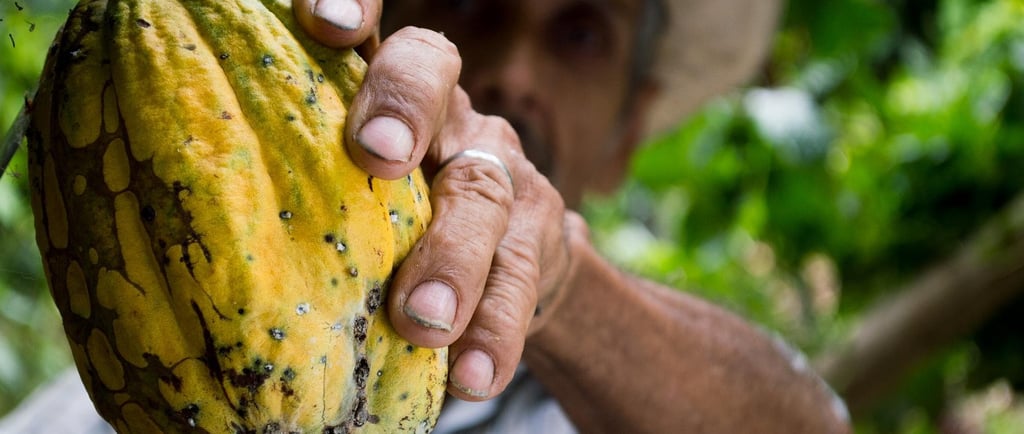
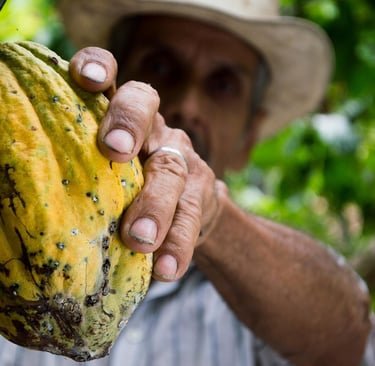
Look closely at this curious fruit I brought today.🍫🌿👀 It belongs to one of the most famous members of the berry family. 🍓🫐🍇 Yes — really! Even though most people call it a cacao pod, botanists say it is actually a kind of berry. That may sound surprising now🤔✨, but later you will discover exactly why scientists place it in this family. 🌱📚🔍
Now feel the skin, or rind 🤲🌰—thick, tough, and protective, like a little suit of armor for the seeds hidden inside 🛡️🌰. This one I brought is full of color ❤️🍂: red, rose, orange, brown, with even tiny hints of yellow and green 💛💚. The long ridges run from top to bottom, and the whole pod bulges, tapers, and curves into an elongated oval shape, almost like a small football 🏉 or a lantern carved by nature 🏮🌿
Inside that rind is the part we cannot see until we cut it open 🔪👀: a soft, wet, slippery white pulp 🤍💧 that wraps itself around each seed like a little blanket. The pulp is often described as sweet-tart 😋🍋, even though the seeds hidden inside are bitter. And when we open the fruit, we find the cacao beans nestled in rows 🌰🌰🌰, packed closely together like passengers on a tiny fruit boat 🚣♀️🍫.
These curious fruits grow in hot, wet tropical lands near the Equator 🌍☀️🌧️, where the air feels warm and heavy, rainclouds roll in and burst open, and green life seems to push and tangle in every direction 🌴🌿🍃. The rain forest buzzes with life, it's a noicy place🐒🐝🦜. And the cacao tree growing there has a surprise for us : instead of hanging its flowers high up in the treetop, decorating its branches like most trees, it grows them right from its trunk and main branches 🌸🌳🍫. You can even spot a little cacao pod growing there. This wonderful trick is called cauliflory 🗣️📜, which means "stem flowering". Let's clap the name 👏🏻 cau-li-flo-ry.👏🏻
One of the first things that makes cacao so remarkable is the way the tree wears its fruits. 🌳🍫✨ Most trees hang their fruits high up in the crown, hiding them among the leaves. But the cacao tree wears its fruits even on its trunk, decorating itself with bright lanterns 🏮🌿. Imagine someone long ago walking through a rainforest 👣🌴. Giant leaves sway overhead, the earth is damp, insects hum, birds call 🐝🦜, and suddenly—there on the trunk of a tree—hang bright, ridged, colorful fruits, right in front of, not up up, but right in front of its eyes hanging fruits, vibrant colors and curious shapes. What a surprising sight that must have been 🤔✨.
The scientists who named this fruit gave us a big hint in its scientific name: Theobroma cacao. 🗣️📜✨ Theobroma is a Greek word meaning “food of the gods.” 🏛️🍫
That grand name helps us imagine how special cacao seemed to many people long ago. As different civilizations began to discover and experiment with cacao, it became much more than a fruit. 🙏🏺✨
For many years, people thought the story of cacao began mostly in Mesoamerica — in lands connected with the Maya and, much later, the Aztec. But newer research suggests that cacao was first domesticated in the Upper Amazon by ancient people of the Mayo-Chinchipe-Marañón culture, in what is now Ecuador and nearby Peru. 🌎🌿🛶 From there, cacao spread through South America and later into Central America and Mexico through human trading and eventually crossed oceans and humans started growing it in other tropical areas.
So cacao’s story is also a migration story — not only of people, but of seeds, skills, recipes, and ideas. But how does this fruit become so important that people carry it across forests, rivers, oceans, markets, and empires? 🤔🍫🌍
It became important because it met many human needs at once. 🍽️💰✨
Human beings long ago had the same fundamental needs we still have today: food, shelter, clothing, protection, transportation, and spiritual needs 🏠🧥🛶❤️. Perhaps at first people tasted the sweet white pulp around the seeds 😋🤍🍽️ — yum, nourishment! People experiment with the bitter seeds hidden inside 🌰🔍. Over time, cacao became much more than a forest fruit. It became a special drink 🥤, a precious thing to trade 💰, a gift for ceremonies 🙏✨, and in some places even a kind of money. That is how this fruit became important enough to travel—from hand to hand, from village to village, from one people to another. 🌍🛶
And once something becomes precious, people do not leave it in just one place. 🌍🛶✨They carry it. They trade it. They plant it in new lands. They tell stories about it. In the Fundamental Needs collection, you may find “A Story of Chocolate,” where cacao pods are the stars of the story 🍫📖🌟.
Cacao traveled through forests 🌳, along rivers 🚣, from village to village and civilizations to civilization 🛖, through markets 🧺, and across languages and oceans 🗣️🌊. It journeyed with traders, travelers, families, growers, and curious people who wanted to taste it, plant it, prepare it and share it. This pod is carrying more than seeds that once people traded like money. It is carrying an ancient stories and traditions for preparing it, waiting for you to discover them when you cut it open 🍫🔪🌿
And now you can see why scientists classify this mysterious lantern from the tropical rainforest as a berry. ✨🍫🌴
I invite you to become scientists and discover it for yourselves. 🔬✨ First, wash your hands thoroughly 🧼🤲. Then cut this cacao fruit open and discover what is hiding inside 👀. Smell the fresh pulp 👃🤍, touch its slippery white covering ✋, and perhaps even taste a little to find out whether it is sweet, sour, or something in between 😋. Count how many seeds are packed in rows, back in time that would be a pod full of money! 🌰🌰🌰. Then, once you have explored it with your own senses, you can research how human beings use these seeds—drying them, roasting them, grinding them, and transforming them into drinks 🥤, cacao nibs, cocoa powder, cacao butter 🧈, and even chocolate 🍫🌱.
🐒 I wonder...which animals help cacao in nature, and which ones eat the sweet pulp?
🤎...what people can make from cacao beans besides chocolate?
🥤...how cacao beans are turned into cocoa powder or cacao nibs?
🧈...what cacao butter is used for?
🕯️...whether cacao beans are used in foods only, or also in soaps, creams, or medicines?
🌍...how different cultures have used cacao beans in different ways?
🌳...what other plants use cauliflory 🌸 and grow their flowers or fruits right on their trunks and main branches, just like cacao?
With Montessori joy,
Vanina 😊