The Renaissance 🔭 A Time of Great Curiosity 🌍✨
🎨🌍 A follow-up story that serves as a bridge between Art, History, and Geography, The Renaissance: A Time of Great Curiosity help children feel the deep unity of human exploration. ✨ Rather than meeting art, history, and geography as separate subjects, the child encounters this cosmic connections here as expressions of the same human drive to observe, imagine, question, and create. This story carries the message that human beings can transform the world through curiosity, courage, and vision. It opens a space for children to sense the invisible relationships between ideas, discoveries, beauty, and changing understandings of the world, while inviting them toward further independent investigation of the Renaissance as a moment when human curiosity reached outward in many directions at once. 💭🔭🏛️📚This journey back in time is sparking the child to wonder: 🎨 How did Renaissance artists made their paintings so real and full of depth?📚 ⚙️ What other discoveries and inventions were made during the Renaissance? 🕰️ What came after the Renaissance
ART STORIESGEOGRAPHY STORIES HISTORY STORIES
3/17/20266 min read
Human beings can do extraordinary things 🌟 They can turn stone into sculpture 🪨 Colours into paintings 🎨 Ideas into buildings 🏛️ And questions into discoveries 🔭Human beings, in every part of the world, have always wondered about life 🌍✨They have asked questions, made beautiful things, and searched for meaning.
About 700 years ago, in Europe, one remarkable period of curiosity, creativity, and discovery began to unfold. During this period, people wondered deeply about art 🎨 About buildings 🏛️About geography and how to orient yourself on Earth 🗺️ About the stars ✨ And about what human beings could do with their hands, their minds, and their imagination.
This time is called the Renaissance 🌱 The word Renaissance means rebirth.
It was called a rebirth because people began to rediscover old ideas, study the world more carefully, and create new things with eagerness and wonder. It was as if curiosity had been sleeping for a long time — and then it woke up 🔥
During this time of rebirth, artists wanted their work to look more real, more alive, and more full of feeling. They experimented with pigments, studied light ☀️ and shadow 🌑, and observed the world very carefully. They looked closely at faces, hands, muscles, and movement. They learned how to show distance in a painting so that it seemed deep instead of flat — almost like looking through a window.
Today we will look at some of the most famous works of art created during this time. There was the Mona Lisa 😊, with her mysterious smile. No matter where you stand, it can feel as though she is quietly watching you. Look carefully at her face — her smile seems to change. Is she smiling more now, or less? How can a painting make a face feel so alive?
There was The Last Supper 🍞🍷, showing a powerful moment of surprise and emotion. Look at the long table, the lines of the walls, and the ceiling. They draw your eyes inward, almost pulling you into the room. And then notice the people — some lean forward, some lift their hands, some look shocked. Can you feel the sudden burst of emotion moving across the table?
There was The Birth of Venus 🐚, where beauty seems to float onto the shore. Venus was the Roman goddess of love and beauty. Why is she standing on a shell? In old stories, Venus was said to have emerged from the sea, so the shell helps tell that story. Look at the flowing hair, the gentle movement, and the soft colours. Does the painting feel still, or does it feel as if the wind is blowing through it?
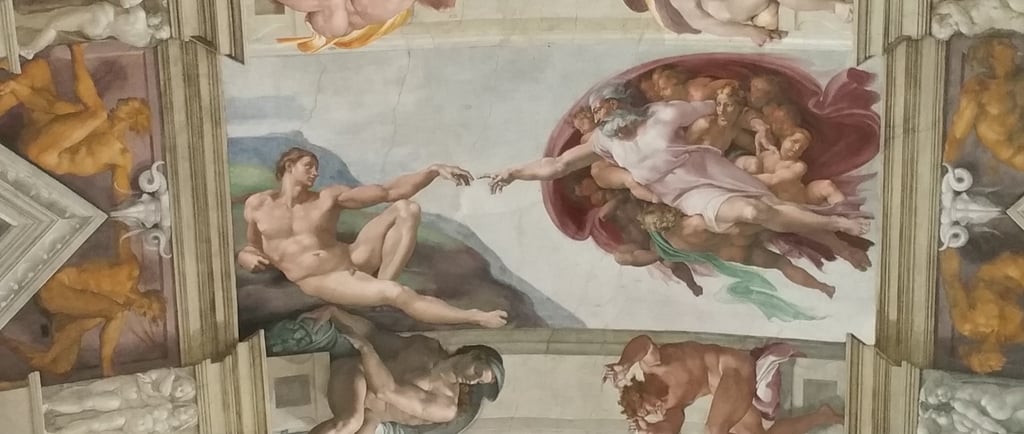
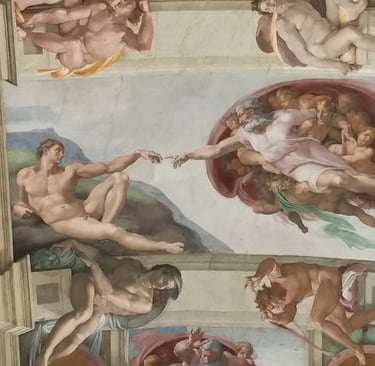
There was The Creation of Adam 🤲⚡, painted high across a ceiling. Look at the two hands — they do not quite touch, and yet the whole painting feels full of energy. Imagine painting such a scene far above your head! This painting is not on an ordinary wall — it is part of the great ceiling! He worked with his arms raised and his head tilted back for hours and hours. Can you imagine trying to draw on your own ceiling? His work took an enormous amount of strength, patience, and determination. He grew tired, but he never gave up. Today, The Creation of Adam reminds us not only of the artist who painted this masterpiece, but also of what human beings can do when skill, imagination, and perseverance come together ✨
And there was the great statue of David 🪨, carved from marble,carved from marble — not with modern machines, but with chisels, hammers, and great patience. Look at his face and his body. He is not shown in the middle of action. He seems to be thinking, watching, preparing. And imagine this too: this enormous figure was carved from a single block of marble. How could stone be made to look so alive?
These artists were not only making beautiful things. They were asking important questions:
How does a body stand? How does cloth fold? How does a face show feeling? How can a painting tell a story without speaking? How can pigments be used so that a painting feels like a window into another world? 🤔
There were no cameras or photographs during the Renaissance 📷❌, so painted portraits were very important. Kings, queens, nobles, and wealthy families often asked artists to paint them. Having a portrait was a kind of luxury — not every person could have one. If you wanted to have a selfie, you must draw self-portrait.
Art became a way of exploring techniques, beauty, and human creativity ✨
But the curiosity of the Renaissance did not stop in the painter’s workshop 🎨It stretched into the streets and across the seas 🗺️ It rose into towers and domes 🏛️ And it reached upward into the sky ✨
People were not only asking how to paint in details. They were also asking big new questions about the Earth, the seas, and the sky. Today, if we are lost, someone might say, “Use your phone!” 📱 But about 700 years ago, there were no phones, no satellite images, no GPS, and no photographs of Earth from space. Maps were usually drawn by hand, often on parchment or paper, and many were beautifully decorated. Some had bright colors, sea monsters, ships, compass roses, and winding coastlines 🌊🐉⛵ They were not always perfectly accurate, especially in places people had not explored well yet. A map during the Renaissance was not just something to help you find your way — it was also a picture of how people imagined and understood the world.
They had to observe carefully. They had to measure. They had to draw maps by hand. They had to travel, compare, calculate, and ask questions. They wanted better maps 🧭They wanted to understand how to travel farther across land and sea wihtout geting lost. 🌊 They wanted to describe the Earth more accurately. And when they looked up at the sky, they had questions there too ✨ About all this shimmering stars above we see every night.
Today, we know that the Earth dances around the Sun ☀️🌍 But during the Renaissance, this was not how most people understood the universe. For a long time, many believed that the Earth stood still at the center of everything.
Then, little by little, some people began to think differently about the sky ✨ They watched the Sun, the Moon, and the planets very carefully. They noticed patterns and asked a brave new question: What if the Earth was not in the center? What if the Earth, like the other planets, was moving around the Sun? ☀️🌍 This idea is called heliocentrism. The word helio means sun — just like in heliotropism, when a plant turns toward the Sun 🌻. In heliocentrism, the Sun is in the center, and the planets move around it.This was a huge change, because many people had believed something different before. Now they were beginning to see the sky in a new way.
New tools helped people look more carefully too 🔭 One of these tools was the telescope. With it, people could see more in the sky than they could with their eyes alone. So the Renaissance was not only a time of artists painting with new skill 🎨 It was also a time of people observing with new attention, and asking questions that changed how human beings understood the world and the universe.
And this same curiosity did not stay only in paintings or in the sky. It could also be seen on the buildings people made during the Renessainse.🏛️
Today, when we see enormous buildings, we may think of cranes, machines, and modern tools. But Renaissance builders did not have the machines we know today. They used planning, mathematics, tools made by hand, and extraordinary human skill.
Architects studied balance, symmetry, arches, and domes. They looked back to ancient Roman and Greek buildings, but they also created new wonders of their own. One of the most famous wonders build back then was the huge dome of Florence Cathedral, which seemed almost impossible to build at the time. Imagine starting a building that your grandchildren might still see being worked on one day 👀🏛️ Florence Cathedral was built over about 140 years. And the dome took about 16 more years to be constructed, not by a famous arcitect, but by a goldsmith 🟡 and watchmaker. ⚙️He studied domes carefully and became deeply passionate about solving this great challenge. Look at the dome from the outside ⛪ See how enormous it is compared with the buildings around it. It rises above the city like a giant crown. 🏛️✨Inside, the dome does not feel like an ordinary ceiling at all. It feels like a whole world above your head 🎨✨
So whether they were painting, mapping, studying the heavens, or building great structures, Renaissance people were driven by the same powerful force: curiosity 🌍✨
One door led to art 🎨 Another led to maps and new ways of understanding the Earth 🗺️ Another opened toward buildings, domes, and beautiful spaces 🏛️ And another opened toward the sky, where people began to see the universe in a new way ☀️🔭
The Renaissance, this particular part of human history, reminds us that human beings are not only able to admire the world — we are also able to question it, study it, transform what we find in nature, and create something new. And perhaps that is one of our greatest gifts 🌟 The Renaissance is just one example in history of what can happen when people look more carefully, think more deeply, and dare to wonder, explore, and search for answers to their questions.
Now I wonder… ❓💭⚙️whether Europe’s Renaissance was the only Renaissance in human history? What other discoveries were made during the Renaissance? 🛠️ What new inventions were created during this time? 🕰️ What came after the Renaissance? ☀️ Who first helped people understand that the Earth moves around the Sun? 🔭 🏛️ I wonder how people built the enormous dome of Florence Cathedral during the Renaissance without modern machines? 🗺️ You may want to make a handmade map and decorate it just as cartographers did over 700 years ago.
With Montessori joy,
Vanina 😊