The Sunflower’s Trip Around the World 🚶♀️🌻🚢
🌻 A follow-up story that branches from The Flower chapter in the Biology Album. 🐝✨ It invites children to follow The Sunflower’s Trip Around the World from its bright “advertising” petals and tiny clustered flowers to its partnerships with pollinators, showing how a sunflower head is really an inflorescence—a busy gathering of many small flowers working together. The story quietly opens hidden doors to the other flower explorations in the chapter:children are introduced to the parts and functions of the flower, to careful observation and classification, and to the many strategies flowers use to ensure pollination. The story links the secret work of plants with the human need for nourishment and the long story of farming. It leaves children wondering: How did early people choose which seeds to save? Which other flowers became important crops? How did pollinators help farming begin? And how did one useful plant travel so far around the world? 🌞🔍🌍
HISTORY STORIESBIOLOGY STORIES
4/18/20264 min read
People long ago had to be careful observers 👀. Before there were farms, stores, or seed packets, families probably gathered seeds from wild plants and noticed, “This one grew taller,” “This one made bigger seeds,” or “That one stayed strong in the wind.” Little by little, they planted the seeds from the plants they liked best. That is one of the great human gifts: we watch, remember, choose, and try again 🔍🧠👐. That is how many crops began. Over many generations, people learned that plants could help with food, shelter, medicine, and beauty, and they slowly shaped wild plants into useful crops.
The sunflower 🌻 was one of those ancient cultivated crops. Botanists noticed how this plant follows the Sun’s movement, and maybe this is part of the reason behind its scientific name, Helianthus annuus 🗝️. Helios is a Greek word for “sun,” and anthos means “flower,” so Helianthus means “sun-flower.” Annuus means “annual,” which is a plant that usually sprouts, grows, flowers, makes seeds, and finishes its life all in one year. ☀️🌻. It is as if the name is saying, “I have one growing season, so I must do my work quickly—reach up, open wide, call the pollinators, and pack my seeds to continue my story!”
The first domesticated sunflowers were developed in eastern North America more than 5,000 years ago 🏕️🌻. We do not know the exact nation or community that first began this work, because it happened so long ago, but archaeologists have found very early domesticated sunflower remains at sites in places such as Tennessee and the eastern woodlands of the United States. What we do know is that Indigenous peoples were already experimenting with this plant long before modern countries existed. By saving and planting the best seeds again and again, they slowly changed sunflower. Wild sunflowers are usually branchy, with many smaller heads and smaller seeds, while domesticated sunflowers became taller, sturdier, and more likely to make the large, seed-filled heads people valued for food.
Once people understood how to grow sunflowers with larger heads and more seeds, they started trading them with other cultures 🚶♀️🌍🚶♂️📦. As people moved through parts of North America, they traded and shared useful plants. Indigenous peoples were not only admiring the sunflower’s bright face 🌻—they were using it in many clever ways too. The seeds could be eaten raw, roasted, cooked, dried, or ground into flour 🍽️. They could be pressed for oil 🫗. Flower buds were sometimes boiled, and roasted seeds could even be used to make a warm drink. Parts of the plant were also used for dyes, body decoration, healing, and ceremony 🎨✨. Among the Hidatsa,( who were hindatsa? ) sunflower was important enough to be carefully cultivated, and in other communities it appeared in stories, seasonal signs, and traditions.
Then, about 500 years ago, in the 16th century, sunflower seeds crossed the Atlantic to Europe 🚢. There, people first loved them as cheerful garden flowers 🌞🌻, but soon they discovered that this was not just a beautiful flower—it was also a useful and nourishing crop. The seeds were eaten as food, and the plant became important for making oil. Later, people began using sunflower oil not only for cooking but also in making soap, paints, and varnishes, which make surfaces glossy and shiny 🧼🎨. Just 200 years ago, sunflower was grown widely and had become a major oil crop which people used to cook with. 🌍💛.
And if we zoom in on the sunflower like a curious bee 🔍🐝, we discover a whole busy neighborhood of tiny flowers packed together. Botanists call this kind of flower head a capitulum—let’s clap it: ca-pit-u-lum 👏👏👏👏. That word comes from Latin and means “little head.” That fits perfectly, because a sunflower head is really a little crowd of flowers all standing shoulder to shoulder. The sunflower belongs to the daisy family, and in this family many tiny flowers work together so closely that from far away they look like one big flower.
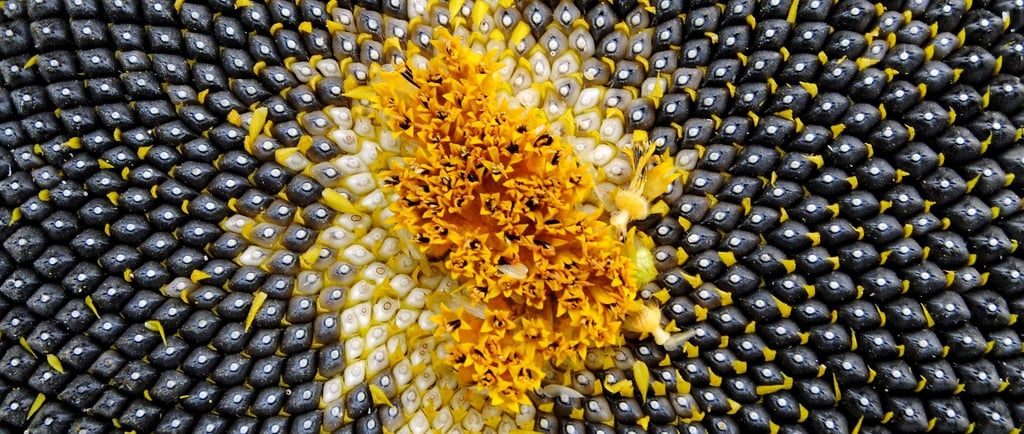
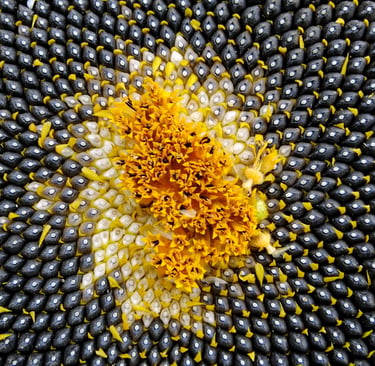
And because this little head is packed with tiny flowers, we can find two types of flowers there. The bright yellow “petals” around the outside are called ray florets 🌼. They are called “ray” florets because they spread outward like rays of sunshine. Each one looks like a single petal, but it is actually its own tiny flower. These ray florets are mostly there to attract pollinators, like a bright sign that says, “Come over here!” 🐝✨. The tiny flowers in the middle are called disk florets. These are the ones that, if pollinated, can make seeds. So the outside flowers are the showy greeters, and the middle flowers are the seed makers. When pollinators visit one sunflower, it is as if they are visiting hundreds or even thousands of little flowers packed together in one grand golden city.
💛 Young sunflower buds are extra sensitive to the Sun. They can follow the Sun across the sky, and when the flower matures it usually ends up facing east and stops following the Sun. Why east? Morning sunlight warms the flower head sooner, and warmer heads tend to attract more bees 🐝.
Once the tiny middle flowers are pollinated, the center of the sunflower begins to fill with seeds 🌻. If you look closely, you can see swirling lines, called spirals 🌀. They cross over one another like little curved roads. If you count them, you often find number pairs like 34 and 55 or 55 and 89. These belong to a famous pattern called the Fibonacci sequence. We might say the sunflower is packing its seeds like a clever puzzle-maker 🧩—fitting in lots of seeds without wasting space. That is why the center can look so tidy, and so beautiful.
🌎🌻 Our ancestors were very good observers. They noticed wild plants, saved seeds, and slowly changed them. The sunflower became one of those great early crops, shaping Indigenous communities in North America, then traveling along pathways of migration and trade, and finally being welcomed into many parts of the world. It feeds birds, insects, and people 🐦🐝👧. It gives us seeds, oil, color, and beauty. And all the while, it reminds us that careful observation can change the world.
I wonder… 🤔🌱 Which country grows the most sunflowers today? How is a wild sunflower different from a domesticated one? 🌻 Which other plants helped people move from gathering food to early farming? 🌾🏡🧺 Which other famous crops were domesticated in North America besides sunflower? 🌾 What other flowers have ray florets and disk florets?
With Montessori joy,
Vanina 😊