Willow’s Secret Pollen Party!🌿🐝
🌳 A follow-up story that branches from The Flower chapter in the Biology Album. 🌿✨ It invites children to discover the hidden world of willow catkins—the fuzzy flyers—who dance in the wind, carrying pollen across great distances. 🌬️🌾 Unlike brightly colored flowers that call to insects, these quiet blossoms rely on air currents to complete their mission. This story connects to other tales of pollination, the co-evolution of plants and animals, and the ingenious ways flowers ensure their survival. How do different flowers choose their pollination partners? 🐝🍃 What would happen if the wind one day stopped blowing? 🌍💭
BIOLOGY STORIES
3/16/20252 min read
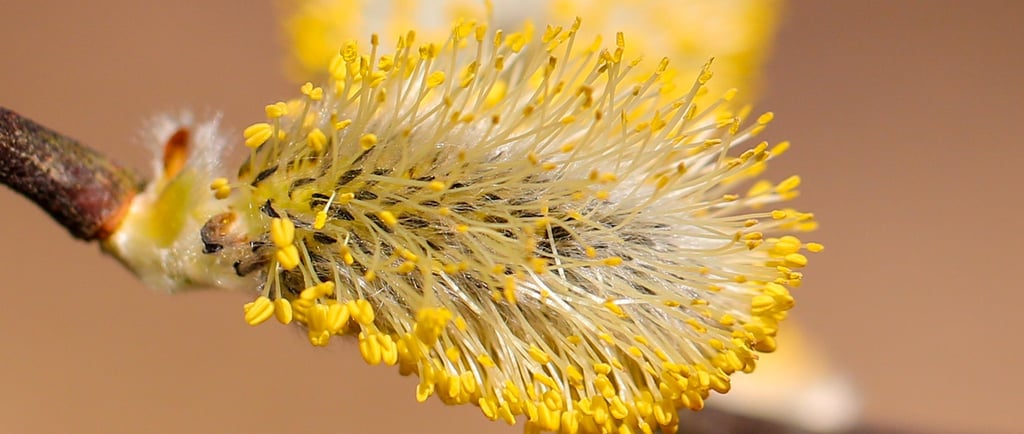
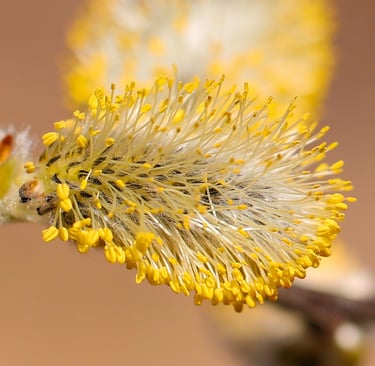
Have you ever walked past a willow tree with its long, sweeping branches cascading down like a green waterfall? 🌿✨ In the breeze, they sway gently, creating a curtain of leaves that dance with the wind. But in early spring the branches look a little different, something fluffy is hanging from them. 🌳✨ Are those little caterpillars? Or tiny tails? Well, that’s a branch with flower buds! They don’t look like regular flowers, do they? 🌸❌ No big, bright petals. No sweet perfume. And yet—they are flowers! 🌼 Very special ones. They are called catkins .
Let’s clap the name together: 👏 cat – kin 👏 The word catkin comes from the Dutch word katteken, meaning “little cat.” 🐈 Why? Because these soft, dangling flowers look just like tiny kitten tails swaying in the breeze! 😺🌿
Most flowers attract pollinators with bright colors and sweet scents, but willow catkins have a different plan. They don’t need bees 🐝 or butterflies 🦋 to help them—although buzzing bees do stop by, tickling the flowers with their fluffy little butts! 🐝😆 Instead, willow catkins trust the wind to carry their pollen far and wide. 💨
If you think the fuzzy buds are fun, wait until you hear what other secrets the willow tree holds! 🌿✨ Willow trees have two types of flowers - male catkins and female catkins.🌿 Male catkins are covered in lots and lots of stamens just like tiny fuzzy caterpillars hanging from the branches. They are staminate (let’s clap! 👏sta-mi-nate 👏). The word staminate comes from the Latin stamen, meaning “thread”— the stamens stick out like tiny golden threads, all loaded with pollen. They hold the pollen and let it fly in the wind. 🎈💨
When the time is right and the catkins bloom, the staminate catkins release a cloud of fine yellow pollen —whoosh! 🌬️✨ It flies through the air, looking for the male catkins of the willow tree where it can land and help grow new seeds. 🌱💛
And here are the female catkins🍃 These are the pistillate flowers (pis-til-late 👏👏👏). Unlike the fuzzy, pollen-packed staminate catkins, these have lots of pistils—each one ready to catch pollen floating in the breeze. Once the pollen arrives, they get to work growing new willow seeds!
Willow trees love water! 🌊🌿 They mostly grow near rivers, streams, and ponds, their roots reaching deep into the moist soil.
These special trees are like nature’s toolbox! People from all over the world have been using willow bark and branches for thousands of years! 🌿💊 It has a special ingredient that helps with fevers and pain. 🎣 Ancient healers used willow bark to treat wounds and stop bleeding. 🌳🩹 It is known as the tree that catches fish! – Native American tribes, like the Quinault people, used willow branches to build fishing traps in rivers. 🐟🌊 Some Native American groups used dry willow wood to start fires by rubbing dry willow sticks together. 🔥🏕️ In the history warriors in some cultures wove willow branches into shields to protect themselves. 🛡️In modern days is famous for 🏏making cricket bats. Some people even weave their own fences using bendy willow branches! 🌱🏡Some artists use the flexible willow branches to create beautiful sculptures—even life-sized animals! 🦊🦢🐘
Next time you walk by a pond or a river, try to spot a willow! 🌊🌳 Watch how its branches dance in the breeze, and see if you can spot its fluffy little catkins before they disappear! 🌿✨
🌳 I wonder… ❓ Can you think of other plants that have separate male and female flowers? How do they spread their pollen?🌬️🌿 Which other trees have catkins?
With Montessori joy,
Vanina 😊